Anthropic's IPO Secret — Skepticism Is Low Status
The secret of every techno-financial bubble is sociological — ambitious visions of the future are rendered conventional, while boring visions become contrarian secrets. Why? Because in a time of euphoria, to be a skeptic is to be low status. While Anthropic was private, the market could put off a hard look at the relationship between LLM capabilities, economic value, and profits. But the IPO makes continued wishful nonthinking untenable and, like AT&T Wireless’s record IPO at the end of the dot-com bubble, heralds a prolonged market correction, if not an outright recession. Later essays in this series examine the capabilities, value, and profit curves from first principles.
In this essay
Anthropic’s initial public offering (IPO) marks the beginning of the end of the AI trade. Up to now, commentators have been intoxicated by talk of “riding the exponential” curve of AI capabilities. But thinking that this implied exponential profit growth was a grave conceptual error. During a technology bubble there is a tendency to believe in fantastical visions of the future — and nothing is more fantastic than a (potentially) $10 trillion company that will put everyone out of work and cure cancer, if its technology doesn’t kill us all first (per its IPO prospectus).
One big “secret about people,” to use Peter Thiel’s terminology,1 is that during a bubble it is the “boring” vision of the future that will be the true one. While Anthropic was private, the market could postpone a close look at the relationships between capabilities and investment, value creation and adoption, and profitability and competition. But now that Anthropic is public it can delay this reckoning no longer, and where we go from here depends on the actual shape of the curves that describe capabilities, value, and profits (see below).
The biggest risk now is “copium” — a portmanteau of cope and opium used to describe the denial, delusions, and weak excuses that most of us use as a mental painkiller when faced with losses or failure in the market. “Sure, AI equities are down 50 to 75 percent from last month’s highs, but they are oversold, and price to earnings ratios are now too low for chip stocks. Jensen just got reinstated as CEO. Anthropic’s second quarter operating profits became a third quarter loss, but Amazon lost money every quarter as it grew into a monopoly worthy of its 1999 valuation. AI is transformational. Anthropic says they will cure cancer. Despite the dot-com bubble, the Internet did change the world. We are all going to make it.” WAGMI, as we say in crypto.
The market humbles everyone, and it is best to learn its lessons quickly.

This series examines the end of the AI trade. The purpose of this essay is to expose a secret — every bubble creates incentives to magnify exaggerated visions of the future — which obscures the narratively “boring” shape of our technological future. Later essays explore the AI trade from first principles, including the trajectory of AI capabilities under the large language model (LLM) paradigm, how these capabilities unlock economic value, and how much of that value the labs can capture, before examining the kind of “boring” future that these curves draw for us.
Of Record IPOs and Market Corrections
A prolonged market correction after Anthropic’s IPO wouldn’t be the first time that a record IPO heralded a market meltdown. Consider the 1990s, which are remembered for the excesses of the dot-com bubble. As fun as it is to mock their silly business plans, dot-com companies were financially inconsequential in the 90s. Only two of the top ten largest technology stocks at the time were software companies — Microsoft and Oracle. And neither was a dot-com startup. The actual bubble heavyweights were, as today, infrastructure companies like Cisco, Texas Instruments, and Applied Materials. Techno-optimism was rampant, fueling a consensus around the advent of a “New Economy” that would soon overtake the old.
On April 26, 2000, AT&T Wireless (ticker: AWE) carried out what was at the time the largest IPO in U.S. history, raising a record $10.6 billion. Within days the stock gained close to 10 percent. But, as it turns out in retrospect, the Nasdaq Composite index had already peaked a few weeks earlier and failed to regain its previous all-time-high. So it is no surprise that after several weeks institutions and insiders began to sell AWE aggressively, driving down its price by nearly 90 percent over the next two years.
The future, in the end, was more boring than the New Economy prophets believed. Better connectivity and higher data throughput arrived many years later, and the mobile revolution itself needed a few more turns of Moore’s Law to make smartphones into true, all-purpose computers. And while more fiber and routers were laid in the 2000s, the beneficiaries were not the infrastructure companies at the heart of the dot-com bubble, which as it turns out were not that valuable, but today’s software platform giants.
Copium says Anthropic is the next Amazon. Might Anthropic become today’s AT&T Wireless instead? It IPO’d at $83, quickly rising to $111, before dropping back toward its IPO price. Like in 2000, it looks increasingly likely that the Nasdaq already peaked. Once valued at nearly $6 trillion, NVIDIA’s stock price dropped nearly 50 percent, though it has regained some ground following the return of ousted founder-CEO Jensen Huang. That sell-off is a large part of the reason that the S&P 500 and the Nasdaq were down 12 and 18 percent from their all-time-highs.
Even if Anthropic (ticker: ANT) does modestly well in its first few weeks as a public company, the big question is, can ANT drive the market to a new all-time-high, or was the IPO the last hurrah before the party ends?
Thinking About Secrets
Why did the market believe the exponential view of the future in the first place? In his book Zero to One, Peter Thiel defined a secret as “unpopular or unconventional truths.” These are either hidden by nature — something that is yet to be discovered — or by people — something that is hidden or unspoken for sociological reasons.
The important secrets are the secrets hidden by people — but these can be more (socially) dangerous because they involve things that one is not supposed to say. Consider Thiel’s “anti-competition” secret, that “monopolists have to pretend that they are small and things are enormously competitive, while non-monopolists have to pretend they are large players with a permanent edge.”
It is indeed curious that Anthropic and OpenAI are so incredibly dramatic in asserting that they have a permanent edge and that they should probably be regulated, if not nationalized, to limit their dominance.
As we shall see in later essays, we do not have to automatically believe (or disbelieve) that frontier labs are natural monopolies. We can reason towards the truth from first principles. If they are monopolies, they should be able to produce monopoly profits. It is not clear that they can.
While the labs might have reason to exaggerate the scale of their future monopoly, why does anyone else take these projections so seriously? Thiel offers explanations for the sociological covering of secrets:
- Incrementalism — a belief, trained and rewarded in academia and the workplace, that the best answers are incremental. If you are too far from the consensus you are not part of the conversation.
- Risk-aversion — for most professionals, it is far better to “fail conventionally,” as John Maynard Keynes liked to put it. Thiel would add that “the prospect of being lonely but right — dedicating your life to something that no one else believes in — is already hard. The prospect of being lonely and wrong can be unbearable.”
- Complacency — elites today do not really need to be right about secrets, they can actually live successful lives without doing so at all.
- Egalitarianism (flatness) — the inability to acknowledge that some people might, in fact, be able to see reality more clearly than others.
The Secret of Every Techno-Financial Bubble
A secret usually supports an ambitious plan, because incrementalism and egalitarianism are the conventions of an otherwise risk-averse world. I would argue, however, that in the middle of a financial bubble it is the ambitious vision that is convention, and the boring vision that is the secret.
As always, it is far safer to make consensus forecasts and fail conventionally. It just so happens that during a bubble the consensus is an exaggerated vision of the future. A market correction is survivable if it is similar to benchmark performance.
Complacency is also rewarded. Riding the bull market wave is profitable, but trying to time a short can be ruinous. Instead, analyst and investor efforts are incremental quests for ever more niche sections of the market.
Combined, this creates enormous FOMO — fear of missing out — which is not just socially but financially enforced. Fund managers will face questions, if not outflows, if their returns do not match those of their peers. The academic research shows that investment strategies spread in this way, and that the higher the returns the more likely it is that investors mimic each other.2 Even venture capitalists have faced the same pressure from their limited partners, who want them to invest into the hottest private companies no matter the price, all of which inflates valuations and depresses returns.
Thiel gives examples of this happening, though he does not work out the dynamic in detail. During the 1990s it was taboo — a secret — to question the market’s attitude towards technology companies. It was equally taboo to suggest in 2007 that mortgage-backed securities would trigger a financial crisis. The Federal Reserve estimated potential subprime losses at about $50 billion, and that was that.3 This was far from the trillions of losses that were eventually realized.
Similar dynamics afflicted the AI trade, which were in turn magnified by most commentators’ inability to think rigorously about the technology. Frontier labs cultivated the aura of Pythagorean cults whose priests held esoteric truths about mathematics, computation, and science. These were communicated to the lay person in a slightly new dialect (compute, light cone, singularity, alignment, you name it). And they had no choice but to take these views at face value, given their lack of technical knowledge with which to think through these claims. The best most commentators do is find a different expert whose conclusions they like better. “I might not be able to read Scripture, so I will find the priest with different views.”
This inadvertently sucked commentators and analysts into San Francisco’s social status games. Nothing could make you more interesting than to say that you “had dinner with some lab people.” The best way to appear “in the know” was to repeat their most dramatic predictions about the future. Maybe AI would “colonize the light cone,” or “misalignment” would create independent “civilizations” of rogue agents instead. Perhaps it was too dangerous to “ride the exponential” because the automation of all work would produce a populist uprising. Or maybe GPT-2 was too dangerous to release to the public (see below).4
To be a skeptic was to be low status.
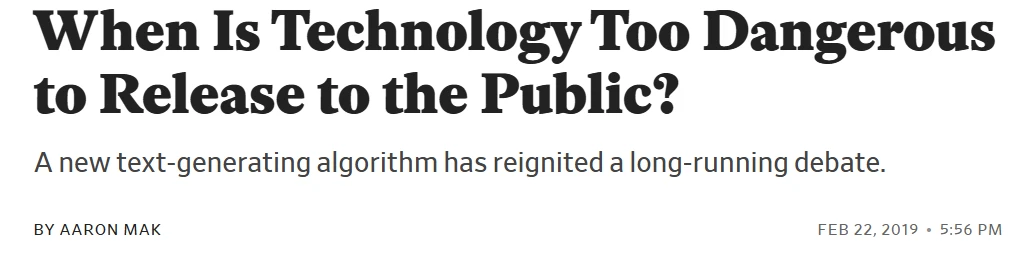
Everyone, from traders and analysts, to politicians and academics, had personal incentive to engage only with the most titillating theses emanating from the frontier. In retrospect, we will discover that this made as much sense as relying on investment bankers to assess the risk of a financial crisis in 2007. Which is why it is no surprise that Michael Burry began shorting NVIDIA last year (he closed out his short this weekend), much as when he famously shorted mortgage-backed securities before the Great Financial Crisis.
Conclusion
The Anthropic IPO is now forcing the market to examine the inconvenient secret that the AI trade was as much about the sociology as the economics of LLMs. Credulous commentators, analysts, and managers will most likely face no lasting reputational damage except for the most egregious failures. This is, after all, the main benefit of failing conventionally.
How does this end? AT&T Wireless suffered talent flight and was acquired by Cingular for about half of its IPO valuation. An inflection point in the market could very well see Anthropic and OpenAI acquired by some of their core investors: the hyperscalers.
If Anthropic does share the same fate as AT&T Wireless, the fallout for the broader economy might be worse than the bursting of the dot-com bubble, which produced a recession only eight months long. If Anthropic and OpenAI are not, in fact, worth $2 trillion, every other AI company will be perceived as wildly overvalued, from neoclouds that rent GPUs to data vendors. Without these valuations, startups — according to corporate card company Ramp, the most lavish spenders5 — will have a harder time raising funds and will have to cut AI spending, which might significantly reduce revenues for frontier labs, and, ultimately, chip makers and compute providers.
Already some investors have been sounding the alarm. To cite just one notable name, earlier this summer Sequoia partner David Cahn calculated that the industry will need to generate $3 trillion to pay back all capex to date, and $1.5 trillion just for 2026 alone.6 In contrast, Anthropic’s and OpenAI’s 2026 combined revenues were only about $100 billion. At this rate, a benign financial outcome for the AI boom now hinges entirely on a deus ex machina7 — in this case, quite literally, the creation of a god in the machine.
Goldman Sachs estimates that the AI investment boom accounts for half of the corporate earnings growth of the S&P 500,8 while Apollo Global Management estimates that it already accounts for 3 percent of GDP.9 Not just a financial crisis, but a really nasty recession could very well be in the not-so-distant future.
So while the pros suffer only modest setbacks, it will be a different story for retail investors who bought Anthropic’s IPO. In crypto circles, WAGMI refers to the idea that market forces will profit even small public investors. But we also have a phrase for the opposite phenomenon. Sometimes projects raise massive sums of private capital at incredible valuations, producing profits for insiders and losses for everyone else — dumping on retail.
Citation
Rincon-Cruz, Manny. “Anthropic's IPO Secret — Skepticism Is Low Status.” Prior Knowledge, November 2026. https://prior-knowledge.ai/essays/the-secret-of-anthropics-ipo/.
-
Thiel, Peter, with Blake Masters. Zero to One: Notes on Startups, or How to Build the Future. New York: Crown Business, 2014. ↩︎
-
See Han, Bing, David Hirshleifer, and Johan Walden. “Social Transmission Bias and Investor Behavior.” Journal of Financial and Quantitative Analysis 57, no. 1 (2022): 390–412; Kaustia, Markku, and Samuli Knüpfer. “Peer Performance and Stock Market Entry.” Journal of Financial Economics 104, no. 2 (2012): 321–338. ↩︎
-
Federal Open Market Committee. “Meeting of the Federal Open Market Committee on March 20–21, 2007.” Transcript, Board of Governors of the Federal Reserve System, 14. https://www.federalreserve.gov/monetarypolicy/files/fomc20070321meeting.pdf. ↩︎
-
Mak, Aaron. “When Is Technology Too Dangerous to Release to the Public?” Slate, February 22, 2019. https://slate.com/technology/2019/02/openai-gpt2-text-generating-algorithm-ai-dangerous.html. ↩︎
-
Kharazian, Ara. “October 2026 Ramp AI Index: Cracks in the AI Thesis, Part 3.” Ramp, October 14, 2026. https://ramp.com/data/ai-index-oct-2026. ↩︎
-
Cahn, David. “AI’s $1.5T Question.” David Cahn’s Substack, July 8, 2026. https://dcahn.substack.com/p/ais-15t-question. ↩︎
-
Cahn, David. “AI CapEx Now Hinges on Deus ex Machina.” David Cahn’s Substack, October 6, 2025. https://dcahn.substack.com/p/ai-capex-now-hinges-on-deus-ex-machina. ↩︎
-
Goldman Sachs. “Can AI Investment Drive S&P 500 Earnings Even Higher?” Goldman Sachs Insights. https://www.goldmansachs.com/insights/articles/can-ai-investment-drive-s-and-p-500-earnings-even-higher. ↩︎
-
“AI Capex Boom Is Growing Twice as Fast as the Housing Boom Did.” Crypto Briefing, August 7, 2026. https://cryptobriefing.com/ai-capex-boom-twice-as-fast-housing-boom/. ↩︎